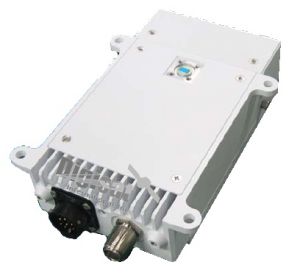
Wavestream Gilat Ka-Band 25W Compact Matchbox Block Upconverter


Transmit Frequency- 30.00-31.0 GHz, IF Freq. 1000-2000 MHz, Reference (10 MHz on IF) 0 dBm ± 5 dB

25 Watt Ka-Band Compact Block Up Converter
The Gilat Wavestream Matchbox 25W Ka-Band Block Up Converter (BUC) leads the industry in linear power for a feedmount-ready package, to ensure maximum available power at the feed flange. The 25 Watt Ka-band compact Matchbox BUC is compatible with Wavestream Ku-band and X-band BUCs, providing a truly modular approach for multi-band capable mobile, flyaway and VSAT terminals.
BUC M&C
The Ka-band Matchbox BUC offers forward power monitoring, 30 dB of step attenuation, serial RS-485, RS-232, or optional Ethernet control interface, and DC input power.
Small Antenna Mounting Footprint
The Kaband BUC’s smaller, lighter weight package facilitates mounting directly onto the feed arm of medium aperture antennas, maximizing the power into the feed.
Efficiency
This Ka-band Block Upconverter uses less energy, helping conserve critical power resources while maintaining system efficiency and performance. This SSPA also includes an Instant On feature to keep systems “mission-ready” and eliminating the warm-up and down time often encountered with more traditional TWTA solutions.
Advantages
 Higher output power with less energy usage. Compact product footprint to meet critical space and weight limitations. Proven reliability and efficiency. Reduced lifecycle maintenance costs.

25W Ka-band Output in a Rugged 14 lb Package, Industry-leading Efficiency with DC Prime Power