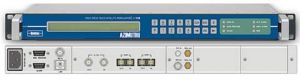
Newtec Azimuth Series AZ928 High Speed Telecom Satellite Demodulator


Interconnects seamlessly with standard terrestrial SDH / SONET networks via a STM-1 or OC-3 interface
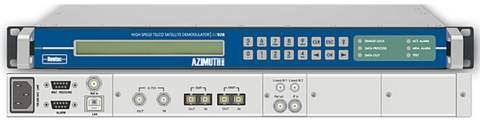
AZ928 Series Satcom Demodulator
This product has reached end of life and has been replaced by the M6100.
Newtec AZ928 is a High Speed Telco Satellite Demodulator that’s used in pair with the High Speed Telco Modulator AZ128 to establish fixed rate 155.52 Mbit/s point to point satellite links. The equipment interconnects seamlessly with standard terrestrial SDH / SONET networks via a STM-1 or OC-3 interface.
The satellite transmission can be operated on 54 MHz or 72 MHz transponders. The modulation is fully compliant with the DVB-S2 standard and provides exceptional power and bandwidth efficiency. When activated on the modulator, the linear and non- linear pre-distortion option Equalink provides an additional link margin improvement of up to 2dB. An adaptive channel equalizer compensates linear link distortion.
16APSK
In standard configuration the AZ928 operates with a 16APSK modulation scheme. The AZ928 is equipped with a dual L-band input (950-2150 MHz). The standard L-band input has the option to deliver 10 MHz over the L-band inter-facility link to the LNB. Optionally one L-band input can be replaced by an IF (50-180 MHz) input. At the output the signal is converted to an electrical G.703 or an optical single or multi-mode signal.
Key features
• 155 Mbit/s transmission on a 54 or 72 MHz satellite transponder
• 16 APSK modulation schemes
• Electrical G.703 and optical interfaces
• Full remote control and monitoring capability that easily integrates with market leading network management systems
Main advantages
• Highest link availability: the AZ928 provides the most efficient link budget available on the market
• Lowest operational costs: full SDH/SONET link in a 54 MHz transponder
• Lowest infrastructure cost: the high power efficiency requires smaller antennas
Applications
• Cable restoration
• Cable back up
• Disaster recovery
• Business continuity
• Internet backbone
• WAN interconnection
Related products
AZ128 High Speed Telco Satellite Modulator
AZ720 Downconverter
AZ730 Up & Downconverter
AZ290 1+1 Demodulator Redundancy Switch
Input interface
Dual L-band input (default)
• Connector 2 x F-type (F), 75 ohms
• Return loss > 7 dB
• Level -65/-25dBm
• Frequency 950 - 2150 MHz
• Adjacent signal < (Co+7) dBm/Hz where Co = signal level density
IF-band input (optional, replaces one L-band input)
• Connector BNC (F) - 75 ohms
• Return loss > 15 dB
• Level -55 to -15 dBm
• Frequency 50 - 180 MHz
• Adjacent signal < (Co+7) dBm/Hz where Co = signal level density
LNB power and control
• max. current 350 mA (on selected IFL input)
• voltage 11,5 -14 V (Vertical polarization) 16 -19 V (Horizontal polarization) & additional 22 kHz +/- 4KHz (band selection according to universal LNB for Astra satellites)
• 10 MHz reference
Reference interfaces
External 10.0 MHz reference input (optional):
• Connector BNC (F) – 50 ohms
• Input level -3dBm up to 7dBm
• Output level +7dBm
LNB reference frequency output (optional, only available with L-band)
• frequency 10 MHz
• stability ±5x10⁻⁸ over 0°C to 65°C
• warm up time 5 min (±100 ppb)
• ageing ±15 ppb/day
± 300 ppb/year
Demodulation
16APSK 8/9 44.14
16APSK 9/10 43.60
BER performance for QEF
Measured
EN302307 performance (*)
Simulations(**) BER ~ 5E-8
Config Es/No Es/No
16APSK- 8/9 12.89 13.3
16APSK- 9/10 13.13 13.6
(*) Measured over Ku-band (with LNB type : SMW PLL) in linear channel
(**) REF BER=1E-10
Synchronization:
• Carrier acquisition range ±8.75 MHz max
• Clock acquisition range ± 200 ppm max.
• Average acquisition time < 3 sec, 90% probability, carrier freq. off set < ± 2.5 MHz ptp and BER<5E-8
Output interfaces
Electrical G.703
• Connector BNC female @ 75 ohms
• Coupling transformer
• Line coding CMI
• Level 1 Vptp (nom.)
Optical Multi-mode
• Connector SC
• Fiber 1300 nm multi mode
62.5/125 mm
• Spectral width 58 nm rms (typ.)
• Transmit power -14 dBm (max.)
-20 dBm (min.)
• Received power -14 dBm (max.)
-30 dBm (min.)
Optical single mode
• Connector SC
• Fiber 1300 nm single mode
• Spectral width 7.7 nm rms (max.)
• Transmit power -8 dBm (max.)
-15 dBm (min.)
• Received power -8 dBm (max.)
-31 dBm (min.)
• Interface rate: 155.52 Mbit/s +/- 20 ppm
Internal Reference frequency
• High Stability (optional)
Stability ±5x10⁻⁸ over 0°C to 70°C
Ageing: ± 15 ppb/day
± 300 ppb/year
• Very High Stability (optional)
Stability ±2x10⁻⁹ over 0°C to 65°C
Ageing: ± 0.5 ppb/day
± 500 ppb/10 year
Generic
Monitor and control interfaces
• Web based GUI
• Diagnostics report, alarm log
• RMCP over TCP-IP/UDP and RS232/RS485
• SNMP v2c
Alarm interface
• Electrical dual contact closure alarm contacts
• Connector 9-pin sub-D (F)
• Logical interface and general device alarm
Physical
• Very compact: 1RU, width: 19”, depth 51 cm, 6 kg
• Power supply: 90-130 & 180-260 Vac, 105 VA, 47-63 Hz
• Temperature
- Operational: 0°C to 40°C
- Storage: -40 to +70°C
• Humidity: 5% to 85% non-condensing
• CE label
• Cable restoration
• Cable back up
• Disaster recovery
• Business continuity
• Internet backbone
• WAN interconnection