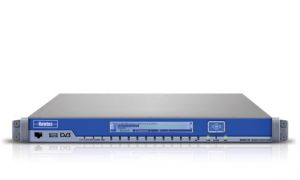
Newtec MDM5000 High Throughput Satellite Modem


High performance unicast service rates up to 120/40 Mbps, Transmit multicast up to 60 Mbps, Embedded TCP acceleration and encryption, DVB-S2X forward

MDM5000 High Throughput Modem
The Newtec High Throughput VSAT Satellite (HTS) MDM5000 is the first VSAT modem on the market that supports DVB-S2X and features symbol rates ranging from 1 up to 133 Mbaud and coding from QPSK to 256APSK in the forward channel, it enables network operators to set-up almost any type and size of network on any available type of satellite – for example, traditional FSS, next generation High Performance Satellites, HTS.
The MDM5000 series supports a wide range of IP Services including internet/intranet access, Voice over IP (VoIP), backbones for mobile backhauling and trunking, contribution and multicasting services. The high-speed capabilities and high efficiency in receive and transmit makes this modem a perfect fit for very bandwidthintensive services in the enterprise, backhauling, offshore and maritime markets.
Return Link Technology Flexibility
For the return channel, a choice can be made between three different return technologies depending on the type of application. The modem supports S2 Extensions SCPC in the return, which allows for highly efficient, medium to high rate dedicated return bandwidth, ranging from 1 to 40 Mbaud for applications such as high speed IP backbones, cellular backhauling, trunking, maritime, mobility and file/video contribution. MF-TDMA mode enables low rate overbooked and bursty traffic profiles for inactive sites in business continuity networks or for always-on connectivity in occasional use networks. The third mode, Mx-DMA, combines the best of both worlds and fills in the gap between MF-TDMA and SCPC.
With Newtec’s Mx-DMA, satellite bandwidth is allocated dynamically in real-time depending on traffic demand, Quality of Service (QoS) profiles and link conditions. Changes are seamless without any packet loss or additional jitter. This allows services with continuously changing rates (from a few kbps up to 60 Mbps) as with MF-TDMA, but at SCPC efficiency. Mx-DMA allows network operators to deploy anything between dedicated to low-to-medium overbooked services at any given time at minimum space capacity cost.
Having the choice between these three return technologies in a network within a single modem guarantees network operators a business model with maximum flexibility in supported applications, responsiveness to new market opportunities and Service Level Agreement (SLA) schemes that fit customers’ needs.

Enhanced IP
For a true broadband experience at minimal bandwidth consumption, the 5000 series incorporates IP traffic enhancement software for TCP acceleration, pre-fetching, compression and encryption. Traffic can be classified in seven different QoS classes based on IP traffic characteristics (protocol types, source/destination address and more). This allows the network operator to provide a flexible hierarchical QoS model depending on any application’s SLA.
Main Advantages
• High throughput upstream and downstream capabilities
• DVB-S2X forward and MF-TDMA, S2 Extensions SCPC and Newtec patented Mx-DMA return link capabilities
• The most optimal modulation and bandwidth allocation while guaranteeing the highest efficiency and availability
• Bolstered with proprietary technologies- FlexACM, Point&Play, HRCTM
• Easy to use multilingual web GUI for installation, diagnostics and troubleshooting
Satellite Link Interface
FORWARD CARRIER (RX)
• Standard DVB-S2/DVB-S2X
• Modulation QPSK, 8PSK, 16APSK, 32APSK, 64APSK, 256 APSK
• FEC BCH/LDPC
53 MODCODs (normal frames):
QPSK: from 1/4 to 9/10
8PSK: from 3/5 to 9/10
16APSK: from 26/45 to 9/10
32APSK: from 32/45 to 9/10
64APSK: from 11/15 to 5/6
128APSK: 3/4; 7/9
256APSK: 32/45; 3/4
13 linear MODCODs (normal frames):
8APSK-L: 5/9; 26/45
16APSK-L: from 1/2 to 2/3
32APSK-L: 2/3
64APSK-L: 32/45
256APSK-L: 29/45 to 11/15
41 MODCODs (short frames):
QPSK: from 11/45 to 8/9
8PSK: from 7/15 to 8/9
16APSK: from 7/15 to 8/9
32APSK: from 2/3 to 8/9
• Roll-off 5, 10, 15, 20, 25 and 35 %
• Symbol rate 1 Mbaud to 133 Mbaud
RETURN CARRIER (TX)
• MF-TDMA mode
Modulation Scheme 4CPM
(Quaternary Continuous Phase Modulation)
Channel bandwidth 128, 192, 256, 384, 512, 768, 1024, 1536, 2048, 2560, 3072, 3584, 4096, 6144, 8192 kHz
MODCODs 0, 1, 2, 3, 4, 5
• Mx-DMA mode
Modulation Scheme HRC
Modulation QPSK up-to 32APSK with 40 MODCODs
Roll-off 5%
Symbol rate 32 kbaud - 20 Mbaud
• SCPC mode
Modulation scheme DVB-S2, S2 Extensions
Modulation QPSK, 8PSK, 16APSK, 32APSK
FEC 1/4, 1/3, 2/5, 1/2,3/5, 2/3,3/4,4/5, 5/6, 8/9, 9/10
Roll-off 5, 10, 15, 20, 25 and 35 %
Symbol rate 1-40 Mbaud
Modem Interfaces
TX INTERFACE – TX1
• Frequency 950 – 1850 MHz/1450 –
2450 MHz (hardware option)
• Connector F-Type - 75 Ohm/N-Type -
50 Ohm (hardware option)
• TX level -55 dBm to +5 dBm
• BUC power supply 24VDC, 4A/48V, 3.5A (hardware option)
• BUC reference 10 MHz/100 MHz
(hardware option)
• BUC reference level +3 dBm (+/- 2 dB)
TX INTERFACE – TX2 (FUTURE USE)
RX INTERFACE – RX 1
• Frequency 950 – 2150 MHz
• Connector F-Type - 75 Ohm/N-Type -
50 Ohm (hardware option)
• RX level -65 to -25 dBm
• LNB power supply 13/18VDC, 500mA
• Polarization selection power supply voltage
• LNB LO selection 22kHz on/off
• LNB Reference 10MHz/100MHz (hardware option)
RX INTERFACE – RX 2 (FUTURE USE)
10 MHZ BUC REFERENCE INPUT
• Connector BNC
DATA INTERFACE
• Local Area Connection (LAN) 100/1000 TX (4/2 X RJ-45, auto MDI/MDIX)
MANAGEMENT INTERFACE
• Local Area Connection (LAN) 100/1000 TX (2 X RJ-45, auto MDI/MDIX)
FUTURE USE
• USB (future use) USB 2.0
• Mass storage option (future use) MicroSD cards
MULTILINGUAL WEB GUI
• Web-based multilingual GUI: no installation of client software required
• Supported web browsers: Internet Explorer, Mozilla Firefox, Google Chrome, Safari
• Management web GUI accessible via configurable management IP address
ANTENNA CONTROL
• Industry standard ACU protocol support
SNMP
• The modem support SNMPv2 for modem performance management.
Performance
LAYER 2 OR LAYER 3
• Max Rx: 200 Mbps
• Max Tx: 60 Mbps
• Maximum concurrent receive multicasts : 10
• Maximum concurrent transmit multicasts: 4
LAYER 3 - UNICAST TRAFFIC
• Concurrent (accelerated): 100/25 Mbps
• Concurrent (non-accelerated): 120/40 Mbps
• Number of TCP connections: 16.000
LAYER 2 - NON ACCELERATED TRAFFIC
• Concurrent receive/transmit : 145/50 Mbps
PPS
• RX: 90 kPPS
• TX: 45 kPPS
• RX + Tx: 60 kPPS
Diagnostics & Configuration
• Self-test on management GUI for end-user and operator troubleshooting including diagnostics for support case reporting.
• Software upgradeable via satellite
Mechanical & Environment
• Housing Height:1RU, width: 19”, depth 44,5 cm
• Weight: 8 kg
• Operational Temperature: 0 to 50 C°
• Humidity: 5% - 95% non-condensing
• Storage: 10 to 60 C°
Power Supply
• Power supply: AC, 50Hz\220-260V and 60Hz\100-130V
DC, 36-76 V (hardware option)
• Modem power consumption: 30W maximum
Standards and Protocols
• EN 302307-1 DVB-S2
• EN 302307-2 DVB-S2X
• EN 301 428 V1.3.1 (2006-02) Ku-band VSAT spectrum usage
• EN 301 459 V1.4.1 (2006-02) Ka-band VSAT spectrum usage
• EN 301 443 C-band VSAT spectrum usage
EMC
• ETSI EN 301 489-1 V1.6.1 (2005-09)
• ETSI EN 301 489-12 V1.2.1 (2003-05)
• ICES-003 Issue 4 (2004)
• FCC: title 47 of the CFR: 2008 part 15(b)
Certification
• Safety EN 60950-1 second edition
• RoHS 2002/95/EG directive compliant
• WEEE 2002/96/EG directive compliant
• CE CE compliant and marked
• UL UL compliant
LAN Interface
• IEEE 802.3 10T Ethernet
• IEEE 802.3u 100TX Ethernet
• IEEE 802.2ab 1000TX Ethernet
• IEEE 802.1q VLANs
PROTOCOLS
• Terminal Authentication, UDP, IP, IPv6, ICMP,
TCP, ARP, FTP, DHCP, IP forwarding, Diffserv,
DNS, IGMPv1/2
Internet/Intranet access, VoIP telephony (SIP, H.323), 2G/3G/rural cellular backhauling, Backbone connections, fiber restoration, FNG/SNG live and file contribution