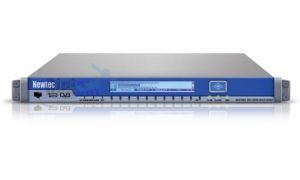
Newtec MDM6100 Broadcast Satellite Modem


DVB-S2X, DVB-S2, DVB-DSNG and DVB-S compliant, QPSK, 8PSK, 16APSK, 32APSK, 64APSK, 128APSK and 256 APSK
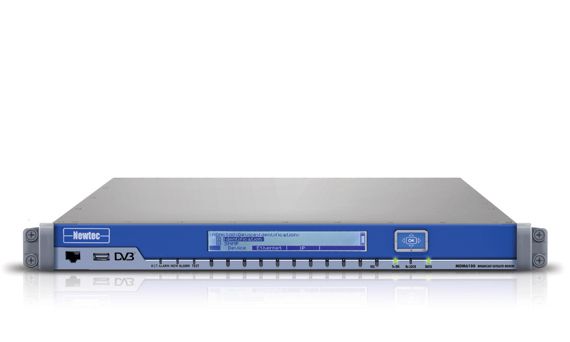
MDM6100 Broadcast Satellite Modem
The Newtec MDM6100 was built upon extensive latest generation RF and flexible programmable technology. Migrating standard distribution links towards the new DVB-S2X standard is as simple as integrating this modem in the head-end while keeping the installed base of IRDs.
A scalable, pay-as-you-grow, licensing and software upgrade mechanism facilitates the launch of new services, or last minute network design changes, without rebuilding the entire network infrastructure. Migration from ASI to GbE and IF to L-band is facilitated by simple in-field installation of license keys.
The brand new DVB-CID carrier identifier is already available as a software option on the MDM6100 and DSNG profiles, as defined by WBU-ISOG, can be easily selected. These profiles define the basic parameters for the most common use cases including the new DVB-S2X standard.

Efficiency at the core
The Newtec MDM6100 Broadcast Satellite Modem is the next generation DVB compliant modem specifically designed for
broadcast applications. The modem supports the DVB-S2 and DVB-S2X, next to the legacy DVB-S and DVB-DSNG standards, as well as Newtec S2 Extensions in order to achieve barrier-breaking efficiency. The unit can act as a single Transport Stream modulator, demodulator or modem.
As a modulator, it is best suited for Broadcast Direct-To-Home, Primary Distribution to Head-Ends and Contribution of elevision
and Radio Content. As a modem or demodulator, it is typically installed in head-ends or at both sides of a contribution link.
The MDM6100 can be used in conjunction with set-top boxes, professional IRD’s or professional satellite demodulators.
Advanced Reliability
Uptime and reliability are essential in the design of the modem, which plays a vital role in the satellite network. Input source
redundancy and the shortest redundancy switch-over times of modems, operating both in 1+1 and N+1 topologies, are setting
the standard in our industry. Advanced capabilities are built in, such as an MPEG Transport Stream analyser, support of SMPTE 2022 FEC at the GbE inputs (for distributed IP headends), and native support of Carrier ID, according to the new DVB standard, as well as in the transport stream NIT Table. Special care was taken to cope with jittery transport stream over IP inputs. Two input ASI and two output ASI ports can be used as monitoring or operational (redundant) interfaces.
Best RF Performance
The Broadcast Satellite Modem performs among the best, offering unmatched bandwidth efficiency optimization options, thereby lowering overall Total Cost of Ownership. The fully automated operation of Newtec´s field-proven Equalink® 3 predistortion technology with its seamless calibration is now available for any satellite transmission application providing up to 10% bandwidth gains in single carrier per transponder constellations.
Clean Channel Technology®, in combination with DVB-S2X or Newtec S2 Extensions, improves satellite efficiency by up to 15%, thereby enabling much smaller carrier spacing. Maximum symbol rates up to 72 MBaud and modulations up to
256APSK (DVB-S2X standard) combined with VCM (Variable Coding and Modulation) allow for maximum throughput in large contribution links.
Related Products
M6100 Broadcast Satellite Modulator
FRC07x0 Frequency converters portfolio
USS0212 1+1 Modulator Redundancy Switch
USS0201 Universal Switching System
Data Interfaces
ASI INTERFACE (OPTIONAL)
Single stream mode
• 2 selectable ASI inputs on BNC (F) – 75 Ohm (coax)
• 2 x ASI output (loop through) on
BNC (F) – 75 Ohm (coax)
• 188 or 204 byte mode
• Rate adapter
• MPTS or SPTS according to ISO/IEC 13818
ETH INTERFACE
• Auto switching 10/100/1000 Base-T Ethernet interface
• Transport stream over IP interface (UDP/RTP)
• Forward Error Correction SMPTE 2022-1 and -2
• 188 or 204 byte mode
• Rate adapter
• MPTS or SPTS according to ISO/IEC 13818
Content Encryption and Protection
BISS ENCRYPTION (OPTIONAL)
• Support for BISS-0, BISS-1 and BISS-E
• On one single TS (SPTS or MPTS)
IP Encapsulation
• Optional MPE Encapsulation of
IP packets in 1 Transport Stream
• Max 20 Mbit/s
IP Decapsulation
• MPE Decapsulation of IP packets received in 1 Transport Stream
• Max 20 Mbit/s
Modulation and Demodulation
SUPPORTED MODULATION SCHEMES AND FEC
• DVB-S
Outer/Inner FEC: Reed Solomon / Viterbi
MODCODs
QPSK: 1/2, 2/3, 3/4, 5/6, 7/8
• DVB-DSNG
Outer/Inner FEC: Reed Solomon / Viterbi
MODCODs
8PSK: 2/3, 5/6, 8/9
16QAM 3/4, 7/8
• DVB-S2 (acc. ETSI EN 302 307 v1.2.1 for DVB-S2)
Outer/Inner FEC: BCH/LDPC
52 MODCODs (short & normal frames)
QPSK: from 1/4 to 9/10
8PSK: from 3/5 to 9/10
16APSK: from 2/3 to 9/10
32APSK: from 3/4 to 9/10
• Newtec S2 Extensions
Outer/Inner FEC: BCH/LDPC
54 MODCODs
QPSK: from 45/180 to 144/180
8PSK: from 80/180 to 150/180
16APSK: from 80/180 to 162/180
32APSK: from 100/180 to 162/180
64APSK: from 90/180 to 162/180
29 Linear MODCODs:
8PSK-L: from 80/180 to 120/180
16APSK-L: from 80/180 to 162/180
64APSK-L: from 90/180 to 162/180
• DVB-S2X standard
Outer/Inner FEC: BCH/LDPC
53 MODCODs (normal frames)
QPSK: from 1/4 to 9/10
8PSK: from 3/5 to 9/10
16APSK: from 26/45 to 9/10
32APSK: from 32/45 to 9/10
64APSK: from 11/15 to 5/6
128APSK: 3/4; 7/9
256APSK: 32/45; 3/4
13 Linear MODCODs (normal frames)
8APSK-L: 5/9; 26/45
16APSK-L: from 1/2 to 2/3
32APSK-L: 2/3
64APSK-L: 32/45
256APSK-L: 29/45 to 11/15
41 MODCODs (short frames)
QPSK: from 11/45 to 8/9
8PSK: from 7/15 to 8/9
16APSK: from 7/15 to 8/9
32APSK: from 2/3 to 8/9
• Support of DVB-S2 VCM mode
(on demodulator and modulator)
BAUD RATE RANGE
Modulator
• DVB-S2, DVB-S2X &
Newtec S2 Extensions 256 kBaud - 72 MBaud
• DVB-S & DVB-DSNG 1 - 45 MBaud
Demodulator
• DVB-S2, DVB-S2X &
Newtec S2 Extensions 256 kBaud - 72 MBaud
• DVB-S & DVB-DSNG 1 - 45 MBaud
FRAME LENGTH
• DVB-S & DVB-DSNG 188 bytes
• DVB-S2 & DVB-S2X
Short Frames 16200 bits
• DVB-S2, DVB-S2X & Newtec S2 Extensions Normal Frames 64800 bits
CLEAN CHANNEL TECHNOLOGY
• Roll-off : 5% -10% -15% -20% - 25% - 35%
• Optimum carrier spacing
• Advanced filter technology
AUTOMATED EQUALINK 3
• Predistortion for all MODCODs
• Calibration without service interruption
RECEIVER POST COMPENSATION NLPC 2.0
• For extra link margin in a multicarrier uplink limited constellation
CARRIER INTERFERENCE REDUCTION
• DVB RF Carrier ID (DVB-CID)
• Spread Spectrum Modulator (BPSK)
• Supports User Data
• Compliant to ETSI 103 129 v1.1.1 (2013-05)
• Carrier ID NIT Table
Modulation Interfaces
L-BAND (CONFIGURATION OPTION)
• Connector N(F), 50 Ohm (optional SMA adapter)
• Frequency 950 - 2150 MHz (10 Hz steps)
• Level -35/+7 dBm (+/- 2dB)
• Return loss > 14 dB
• Switchable 10MHz Reference
• Spurious performance
Better than - 65 dBc/4 kHz @ +5 dBm output level and > 256 kBaud
Non-signal related: < - 80 dBc @ +5 dBm output
IF-BAND (CONFIGURATION OPTION)
• Connector BNC (F) - 75 Ohm
(intermateable with 50 Ohm)
• Frequency 50 - 180 MHz (10 Hz steps)
• Level -35/+10 dBm (± 2 dB)
• Return loss 50 Ohm : > 14 dB
75 Ohm : > 20 dB
• Spurious performance
Better than - 65 dBc/4kHz @ +5 dBm output level and > 256 kBaud
Non-signal related:< - 80 dBc @ +5 dBm output
L-BAND MONITORING
• Connector SMA (F), 50 Ohm
• Frequency Same as L-Band output frequency or 1050 MHz in case of IF output option only
• Level -45 dBm
• Return loss > 10 dB
10 MHZ REFERENCE INPUT
• Connector BNC (F), 50 Ohm
• Input level -3 dBm up to + 7 dBm
• Frequencies 1,2,5,10,20 MHz
10 MHZ REFERENCE OUTPUT (OPTIONAL)
• Connector BNC (F), 50 Ohm
• Output level +3 dBm (+/- 2dB)
BUC POWER (OPTIONAL)
Max. current: 3.8A
Voltage: 24V,48V (Software controlled)
Demodulation Interfaces
DUAL L-BAND INPUT (DEFAULT)
• Connector 2 x F-type (F), 75 Ohm
• Return loss > 7 dB (75 Ohm – F(F))
• Maximum total input power: - 10 dBm
• Maximum input signal power: (-30 + 10log(f))dBm where f=baud rate in MBaud
• Minimum input signal power: (-80+Es/ No(thr)+10log(f))dBm where f=baud rate in MBaud and Es/No(thr)= Es/No value in dB for QEF reception
• Frequency 950 - 2150 MHz
• Adjacent signal < (Co+7) dBm/Hz with
Co = signal level density
IF-BAND INPUT (OPTIONAL, REPLACES ONE L-BAND INPUT)
• Connector BNC (F) - 75 Ohm
• Return loss > 15 dB
• Input power: add 10 dB to the L-band input spec above
• Frequency 50 - 180 MHz
• Adjacent signal < (Co+7) dBm/Hz with
Co = signal level density
LNB POWER AND CONTROL
• Max. current 350 mA (on selected IFL input)
• Voltage
11,5 -14 V (Vertical polarization)
16 -19 V (Horizontal polarization) & additional
22 kHz +/- 4KHz (band selection according to universal LNB for Astra satellites & DiSEqC command transmission)
Internal 10 MHz Reference Frequency
STANDARD STABILITY
• Stability: +/- 2000 ppb over 0 to 70°C
• Ageing: +/- 1000 ppb/year
VERY HIGH STABILITY (OPTIONAL)
• Stability: +/- 2 ppb over 0 to 65°C
• Ageing: +/- 500 ppb/10 year
Generic
MONITOR AND CONTROL INTERFACES
• Web server GUI (HTTP) via web browser
• M&C connectivity via separate Ethernet links
• Diagnostics report, alarm log (HTTP)
• SNMP v2c
ALARM INTERFACE
• Electrical dual contact closure alarm contacts
• Connector 9-pin sub-D (F)
• Logical interface and general device alarm
Physical
• Height 1RU, width: 19”, depth 51 cm, 5.8 kg
• Power supply:
90-130 & 180-260 Vac, 125 VA, 47-63 Hz
• Temperature:
Operational: 0°C to +50°C / +32°F to +122°F
Storage: -40° to +70°C / -40°F to +158°F
• Humidity: 5% to 85% non-condensing
• CE label and UL
Not only a modem, it’s a platform that takes a vital role in your networks, performs the best on the market and helps you evolve your business through ongoing market and technology innovations