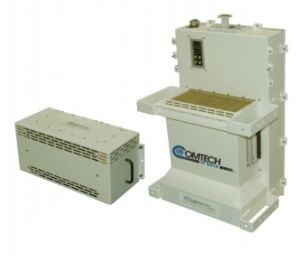
Comtech EF Data LPOD C-Band SSPA BUC (Block Upconverter)


Available in C, X, or Ku-Band configurations

LPOD C-Band SSPA BUC
Comtech EF Data’s extensive experience in the design of outdoor RF transceivers led to the LPOD family’s efficient thermal and mechanical package. Recognizing the evolution of L-Band IF systems, the LPOD is designed to eliminate the traditional requirement for the modem to supply a DC power source and a 10 MHz reference to the BUCs and LNBs. The LPOD’s optional internal reference and LNB bias T greatly simplify multi-carrier operation and provide cost-effective redundant solutions. The LPOD offers valuable features not found in other L-Band BUC products.
Internal 10 MHZ Reference
With the optional high-stability, ovenized reference oscillator (OCXO) installed, one more signal is removed from the TX IF cable. This ensures optimum RF performance of the BUC by eliminating any reference degradation caused by IF combiners, interconnections or rotary joints.
Optional Single and Multi-Band LNB Support
The LPOD was designed with the evolution of L-Band systems in mind. No longer relegated to low power single carrier installations, L-Band IF topologies are now found in larger multi-carrier installations. A challenge presented by multi-carrier L-Band systems is the presence of DC and reference components on the TX/RX L-Band interfaces. The LPOD design, by default, eliminates the DC component from the TX IF and can eliminate the reference requirement with the optional internal OCXO. The LNB bias/reference option completes the solution by eliminating DC and reference signal requirements from the RX L-Band interface. We also offer a high-stability “Multi-Band” Ku LNB facilitating global Ku-Band downlink coverage controlled by the LPOD M&C.
Redundancy
Another challenge addressed by the LPOD topology is the increasing need for redundant L-Band RF solutions. With its internal power supply, internal reference and internal LNB bias capability, the LPOD offers a very cost-effective solution for 1:1 redundant TX and 1:1 redundant RX requirements.
Integrated Power Supply
All LPOD models have a self-contained power supply. This eliminates the requirement for the modem to supply the BUC voltage on the center conductor of the RF cable, simplifying multi-carrier operation and modem spares maintenance.
Data Logging Capability
To greatly enhance system maintainability, the LPOD line includes a built in data logging capability. By recording critical operational parameters (such as temperature, output power, mute status, etc.) at time stamped intervals, the user can quickly gather intelligence not only about the unit itself, but also the unit’s operational environment.
Advanced FSK
The LPOD, when used with Comtech EF Data modems, provides valuable additional functionality utilizing the industry standard FSK communications channel. This feature offers full control of single thread and redundant systems from the modem front panel without additional cabling or cost. The LPOD can also be accessed from the Ethernet port of the modem and controlled via Embedded Distantend Monitor and Control (EDMAC).
Hand-Held Controller Devices
A variety of hand-held controller devices are available. These include the LPODnet M&C Accessory Kit and the CLC-10 M&C Accessory Kit. Both are designed to access the monitor and control functionality of the LPOD family of products.
C-Band LPOD Specifications |
|
Characteristics |
|
|
IF Input Frequency[1] |
950 - 1525 MHz |
|
RF Output Frequency |
5.850 - 6.425 GHz |
|
Max IF Input level (no damage ) |
+10 dBm |
|
Gain Adjust |
20 dB in 0.25 dB steps |
|
Gain Flatness |
± 1.5 dB full band (± 1.0 dB PS2 configured as SSPA only) |
|
Gain variation over temp |
±1.5 dB max, -40 to +55 °C |
|
Input Return Loss |
15 dB |
|
Output Return Loss |
19.1 dB (1.25:1 VSWR) |
|
Noise Figure |
10-15 dB typ, 20 dB max @ min. attenuation, (8 dB typ, 15 dB max PS2 configured as SSPA only) |
|
RF Mute Isolation |
-60 dBc min |
|
AM/PM Conversion |
2° typ., 3.5° max. @ Rated P1dB |
|
3rd Order Intermod. Level (2 tones, @ -3 dB Total Back Off from P1 dB (-6 dBc SCL), Δ 1 MHz) |
-30 dBc typ., -25 dBc Guaranteed |
Spurious Level |
|
|
Harmonics |
-50 dBc @ Prated - 3dB |
|
Carrier Related In Band |
-60 dBc min. @ P1dB |
|
Non-Carrier Related In Band |
-60 dBm max.( Input Terminated) |
|
LO Leakage |
-25 dBm max. ( Input Terminated) |
|
Group delay variation |
Linear ± 0.03ns/MHz |
Optional Internal reference |
|
|
Internal Reference Oscillator Frequency |
10 MHz(Can lock to modem supplied reference over a range of -5 dBm to +5 dBm at IF Input) |
|
Frequency Stability |
±5 x 10⁻¹⁰ / day |
Optional LNB BIAS/Reference |
|
|
LNB Bias Voltage |
22 ±1V @ 450mA max |
|
LNB 10 MHz Reference Output Level |
0 dBm ±5dB |
|
LNB Input/Output Return Loss |
15 dB |
|
LNB Input/Output Gain |
10 dB ± 2 dB (950-1750 MHz) |
|
LNB Input/Output Gain Flatness |
± 1 dB (950-1750 MHz) |
|
LNB input/Output Isolation (Mute condition) |
55 dB min |
Environmental |
|
|
Temperature |
|
|
Humidity |
100% condensing rain 2” per hour |
|
Altitude |
10,000 AMSL |
|
Shock |
Normal commercial shipping and handling |
Physical |
|
|
Weight / Dimensions |
|
Video Broadcast, Satellite Teleports, Military Communications, Internet Access Services, Disaster communications, Telco Restoral Services, VOIP Services