
DEV 7134 RF Over Fiber Indoor Chassis
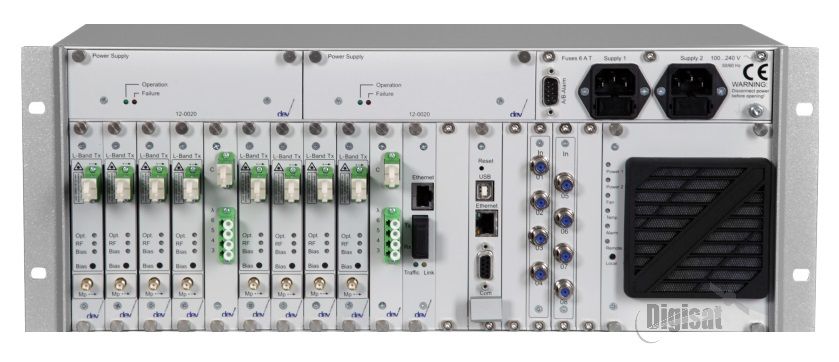
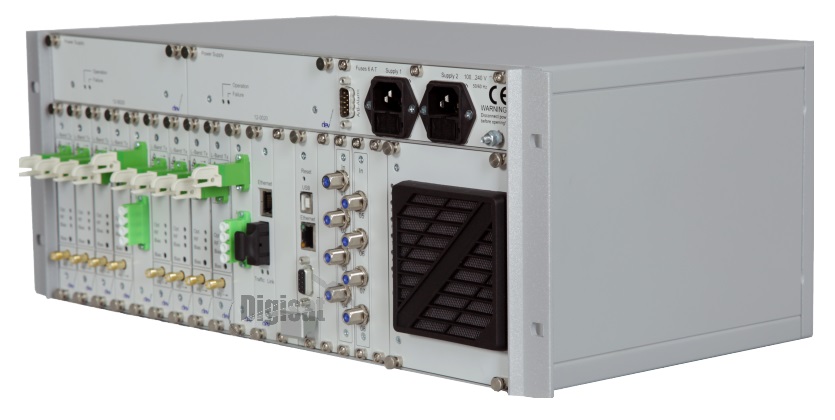
DEV 7134 RF Over Fiber Optic System
The DEV 7134 is a 4 RU chassis providing 12 Slots for RF over Fiber transmit and receive modules of theoptribution chassis. OPTRIBUTION is a registered trademark of DEV Systemtechnik and comprises RF signal transmission products for the Optical Transmission and Distribution of RF Signals. The product family covers transmission from RF to optical and from optical to RF between antenna and receiver. series. With its redundant power supplies and the built-in controller all functionalities are accessible and to monitor via the Web Interface or the SNMPSimple Network Management Protocol (SNMP) is a remote protocol used for managing devices in M&C Systems. Protocol. All control is front panel accessible; the chassis becomes the SMART Intelligent Optribution Chassis.
FEATURES
- 20 Slots for optical Tx- or Rx- RF over Fiber Modules for up to 40 Signals
- CWDM capable, up to 8 channels- Ethernet to Optical Converter
- DEV Web Interface
- 50 Ohm SMA (f) and 75 Ohm F (f)
- Automatic Switch Back for 1+1 redundancy schemes
- Redundancy Path Gain Compensation (RGC) for N+1 redundancy schemes
- Signal Recording and Data Backup
- SNMP Support - Power Supply Redundancy
BENEFITS
- Providing front accessibility for every module - Wall mountable and half depth for applications with strict space requirements
- Permanent Signal Monitoring and Recording
- Enhanced System Reliability via 1+1 redundancy - Intuitive and complete Operation with DEV Web InterfaceThe DEV Web Interface is an enhanced graphical user interface (GUI) to monitor and control all functions, features and settings available for DEV devices. Simultaneous access of an unlimited number of users is possible.
- Complete SNMP-MIB for seamless Integration into all common M&C Systems
Specifications
Capacity
Front Side 12 Slots (max. 12 Optical Channels with Single Link Modules,
max. 16 Optical Channels with Twin Modules)
Remote Communication
Interface (Connector) • Ethernet (RJ-45)
Remote Control & Surveillance
(Interface)
• via Web Interface (Ethernet);
• via SNMP (Ethernet).
Redundant Power Supply
Supply Voltage 100…240 V AC supplied by two different Lines
Power Consumption <100 VA
General Specifications
Size 19” (483 mm) Width, 4 RU (178 mm) Height,
~255 mm Depth + max. 80 mm (optical Connectors)
Weight ~8 kg (empty Chassis)
Environmental Conditions ETS 300019 Part 1-3 Class 3.1
Option 28 Automatic Switch Back
Automatic switch back enables the autonomous switch back from the redundant link to the main link
based on the RF sensing functionality.
Available in combination with 1+1 Rx redundancy options, only
Option 55 Change Ethernet to optical Ethernet Interface; 30 km
Option 56 Change Ethernet to optical Ethernet Interface; 1530 nm; 100 km
Option 57 Change Ethernet to optical Ethernet Interface; 1550 nm; 100 km
With Option 55, Option 56, or Option 57 the CPU module of the device provides a 100Base-FX
Ethernet interface with SC/PC connectors (instead of the standard 100Base-TX Ethernet interface
with RJ-45 connector) for the optical transmission of Ethernet signals.
Cabling Options
Cabling options are used for stand alone optical Tx or Rx modules.
Available in 50 Ohm with SMA (f) or in 75 Ohm with F (f) connectors
Available for DC…3000 MHz, or for 10…1006 MHz, or for DC, 700…2300 MHz
1+1 Redundancy Options
1+1 redundancy options are used to realize a redundant optical link to a dedicated main link.
Available for DC, 950…2150 MHz, in 50 Ohm with SMA (f) or in 75 Ohm with F (f) connectors
Up to 4 times with single link modules and up to 8 times with twin modules for Rx redundancies
Up to 6 times with single link or twin modules for Tx redundancies
A mix of single link and twin modules is not allowed
A mix with stand alone optical Tx or Rx modules is allowed
A mix with n+1 redundancy options is not allowed
Link gain will be decreased by ~5 dB
Return Loss >14 dB
Slot Requirements • 3 Slots for a single 1+1 Redundancy with Single Link Modules
• 5 Slots for two 1+1 Redundancies with Single Link Modules
• 3 Slots for two 1+1 Redundancies with Twin Modules