
Novra Technologies A75 ATSC Video and Data Satellite Receiver


Receiving Frequency: 54 to 806 MHz, - RF Input Connector: F-Type, 75 ohms, Ethernet 10/100 Base-T LAN Interface: RJ-45, Image Rejection: > 70dBc
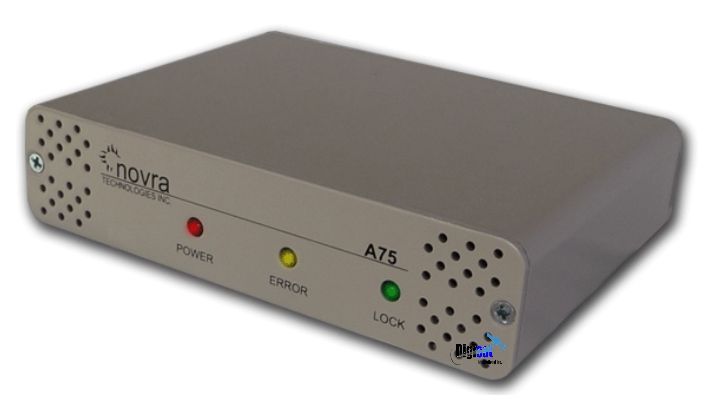
Novra A75 ATSC Receiver
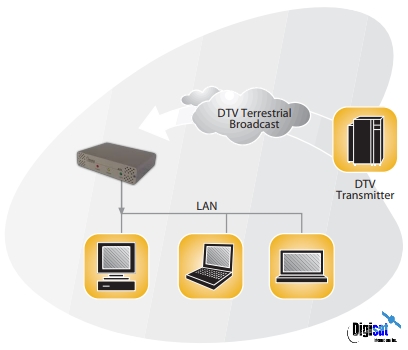
The Novra A75 is a compact and robust receiver that is designed for datacasting and video applications over ATSC broadcast signals (ground-based digital TV channels). It will receive an ATSC signal and pass available IP or MPEG data onto your LAN. The A75 provides the following features: The A75 provides the following features: ATSC Compliant, 8-VSB Demodulation, Full 6 Mhz Channel Utilization (19.38 Mbps Sustained Throughput), RJ45 10/100BaseT Ethernet Interface, IGMP Support, Compact Form Factor.
This enables you to configure your A75 as:
- A standard ATSC IP data receiver, or
- As an MPEG content aggregation and distibution point
The ATSC elementarty stream PIDs are passed directly onto the host LAN for redistribution or viewing. A special variant of this receiver, the A75-TS, is also available to enable the full transport stream to be passed intact onto the host LAN. As with previous A75-based receivers, the RJ45 Ethernet connection provides powerful and distinct installation, performance, and maintenance advantages compared to USB or PCI form factors. Installation of the A75 is easy and non-invasive. No drivers are required and no computer needs to be opened. The A75 works with any operating systems and makes the received data available to any device on the LAN.
Features
- Exceptional Cost / Performance
- Full 6 Mhz channel utilization (19.38 Mbps)
- TCP / UDP / Unicast / Multicast
- ATSC Compliant
- Application Transparent
- Small Footprint
- IGMP Support
- RJ45 10/100BaseT Ethernet Interface
- PID Filtering
- Video Forwarding Features
- Multi-PID Mapping to a Single MCAST Address
- Raw Transport Stream Forwarding
- Optional Multicast of full DVB Multiplex onto LAN (A75-TS)
Designed for datacasting and video applications over ATSC broadcast signals (ground-based digital TV channels).