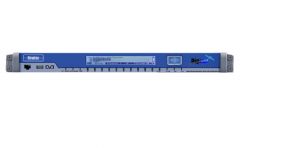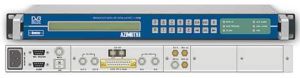
Newtec Azimuth Series AZ840 BISS Scrambler
Supports BISS-1 & BISS-1
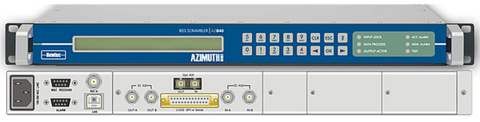
Newtec AZ840 BISS Scrambler
This product has reached end of life and has been replaced by the M6100
The Newtec AZ840 is a transport stream scrambler fully compliant with the BISS-E standard. It supports the two modes of operation: BISS-1 and BISS-E.
BISS (Basic Interoperable Scrambling System) is the ultimate cost effective solution for reliable and interoperable protection of contribution and DSNG exchanges. The main advantages of BISS are its simplicity and flexibility combined with free access to both every manufacturer and user.
BISS is also a simple and efficient conditional access solution for the primary distribution of programs between a hub and CATV, Digital Terrestrial Television or mobile TV remote distribution sites. In this case, BISS is the ideal solution to protect regional broadcasting rights.
The Newtec Azimuth Series AZ840 scrambles one program of the ASI transport stream with a programmable Session Word. This Session Word remains valid for the whole transmission period. In Mode 1, the Session Word is programmed in the scrambler in the clear.
In mode E, the session word itself is encrypted with a DES algorithm before being programmed in the scrambler. The Encrypted Session Word is encrypted with the Identifier (ID) of the scrambler. There are two possible Identifiers: the buried ID and the injected ID. The buried ID is hardcoded in the device and the injected ID can also be programmed.
The scrambler automatically updates or adds the DVB SI tables, adapts the output rate and re-stamps the PCR clock references in the transport stream. In its default configuration, The AZ840 has 2 ASI inputs which can be selected either manually or automatically. One of the Electrical ASI interface can be optionally replaced by an optical interface. Optionally, a high stability reference frequency can be implemented.
Key features
• Scrambles 1 Program in 1 Transport Stream
• Compliant to BISS Standard-Mode 1 & E
• 5 user-defined Injected Identifiers
• Up to 10 Buried Identifier changes allowed
• ASI or optical input
• Integrated rate adapter
Main advantages
• Simple and Cost effective solution
• Non-proprietary
• Compatible with all professional IRDs
Related Newtec products
AZ110 Broadcast Satellite Modulator
AZ200 Universal Switching System
Interfaces
ASI Electrical inputs
• Connector BNC (F), 75 ohms
• Return loss (22-270 MHz) 17 dB
• Coupling transformer
• Sensitivity 200 mVpp
• Max input 880 mVpp
• Interface rate 270 MBaud ± 100 ppm
• TS packet formats 188 or 204-byte
• Packet timing (burstiness) compliant to DVB burst & byte mode
ASI Electrical outputs
• Connector BNC (F), 75 ohms
• Coupling transformer
• Level 800 mVpp ± 10%
• Rise time < 1.2 ns
• Interface rate as per DVB-A010 Rev1.
ASI Optical input (optional)
• Connector SC
• Fiber 1300 nm multimode
62.5/125 mm
• Received power -27dBm to -14 dBm
ASI Optical output (optional)
• Connector SC
• Fiber 1300 nm multimode
62.5/125 mm
• Transmit power -19dBm to-14 dBm
• Wavelength 1270 nm < l < 1380 nm
10 MHz reference input / output (optional)
• Connector BNC (F), 50 ohms
• Input level -3dbm up to 7dBm
• Output level +7dBm
Internal Reference frequency (optional)
High Stability
Stability ±5x10⁻⁸ over 0°C to 70°C
Ageing: ± 15 ppb/day
± 300 ppb/year
Very High Stability
Stability ±2x10⁻⁹ over 0°C to 65°C
Ageing: ± 0.5 ppb/day
± 500 ppb/10 year
Scrambling
Supported standards
BISS Mode 0 (clear)
BISS Mode 1 (clear SW)
BISS Mode E (encrypted SW)
Maximum number of injected IDs 5
Buried ID User defi ned, maximum 10 changes allowed
Number of scrambled programs Maximum 1
Maximum Speed 50 Mbit/s
Generic
Monitor and control interfaces
• Web based GUI
• Diagnostics report, alarm log
• RMCP over TCP-IP/UDP and RS232/RS485
• SNMP v2c
Alarm interface
• Electrical dual contact closure alarm contacts
• Connector 9-pin sub-D (F)
• Logical interface and general device alarm
Physical
• 1RU, width: 19”, depth 51 cm, 6 kg
• Power supply:
90-130 & 180-260 Vac, 105 VA, 47-63 Hz
• Temperature
- Operational: 0°C to 40°C
- Storage: -40 to +70°C
• Humidity: 5% to 85% non-condensing
• CE label
• Contribution and DSNG exchanges
• Primary distribution