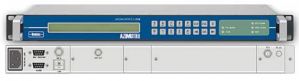
Newtec Azimuth Series AZ420 Telco Satellite Modem
DVB-S2 & DVB-DSNG, 50 Mbps IP processing capability

AZ420 Series Telco Satellite Modem
This product has reached end of life and has been replaced by the Newtec M6100.
The Newtec Azimuth Series AZ420 is a state-of-the-art satellite modem designed for fixed rate telco, voice and data applications over satellite in full compliance with the DVB standards. This modem connects directly with terrestrial data and voice networks through a standard G.703 interface.
In its default configuration, the AZ420 supports E1 rates. The support of E2, T2, E3 and T3/DS3 rates are available as configuration option. It is also possible to configure the modem with a secondary G.703 input/output, for the implementation of a redundant configuration or to allow the modem to be compatible with two different transmission rates.

L-Band
At the output of the modulator, the signal is available on an L-band interface. Extended L-Band, IF band as well as HPA control functions are available as configuration options. When activated, the unique linear and non- linear predistortion option Equalink provides an additional link margin improvement of up to 2,5dB.
On the receive side, the Newtec AZ420 has a dual L-band input( 950-2150 MHz). The active L-Band input is selected by the user and can provide DC power and frequency band selection signals compatible with most professional and commercial LNBs.
Optionally one L-Band input can be replaced by an IF (50 – 180 MHz). An adaptive equalizer compensates linear distortion of the transmission channel and the integrated Noise & Distortion Estimator (NoDE) tool provides an accurate reading of the satellite link margin even in presence of non-linear distortion and allows the user to fi nd the optimum input back-off setting very easily for 16APSK or 32APSK operation, whether or not nonlinear predistortion is applied .
Key features
• DVB-S2 and DVB-DSNG/S compliant
• QPSK, 8PSK, 16APSK and 32APSK
• G.703 interface with E1, T2, E2, E3 or T3/DS3 rates
• L-band monitoring output
• Programmable amplitude slope equalizer
• Adaptive equalizer (demodulator input)
• Noise & Distortion Estimator tool (NoDE)
• Optional Extended L-Band (950 - 2150 MHz)
• Optional 10 MHz reference input/output
• Optional Linear and non-linear predistortion (EqualinkTM)
• Featured-based pricing and software upgradability
Main advantages
• Lower operational costs thanks to highest bandwidth efficiency
• High compactness
• Fully compatible with the satellite DVB standards
Related products
AZ120 Telco Satellite Modulator
AZ920 Telco Satellite Demodulator
AZ7x0 Frequency converters
AZ200 Universal Switching SystemAZ910 DSNG and Contribution Demodulator
AZ7x0 Frequency converters
AZ200 Universal Switching System
Input/output interface
G.703 input/output
Connector : BNC (F)
Impedance : 75 ohms
Rate : 2.048 ; 6.312 ; 8.448; 34.368 ;
44.736 Mbps
Clock stability – G.703
2 Mbit/s : ± 50 ppm
6 & 8 Mbit/s : ± 30 ppm
34 & 44 Mbit/s : ± 20 ppm
Line coding
fully compliant to the ITU-T G.703 standard
HDB3 for E1, E2, and E3
B3ZS for DS-3 (T3)
Adaptive equalizer with 4 preset values,
compensating cable lengths up to 1350 ft
Modulation and demodulation
Supported modulation schemes and FEC
• DVB-S/DSNG:
Outer/Inner FEC: Reed Solomon /Viterbi
MODCODs:
QPSK: 1/2, 2/3, 3/4, 5/6, 7/8
8PSK: 2/3, 5/6, 8/9
16QAM: 3/4, 7/8
• DVB-S2:
Outer/Inner FEC: BCH/ LDPC
MODCODS:
QPSK: 1/4, 1/3, 2/5, 1/2, 3/5, 2/3, 3/4, 4/5,
5/6, 8/9, 9/10
8PSK: 3/5, 2/3, 3/4, 5/6, 8/9, 9/10
16APSK: 2/3, 3/4, 4/5, 5/6, 8/9, 9/10
32APSK: 3/4, 4/5, 5/6, 8/9, 9/10
Baud rate range
mod demod
• DVB-S2 0,05 - 45 0,256 - 45/33
• DVB-S/DSNG 0,05 - 45 1 - 45
Frame length
• DVB-S/DSNG 188 bytes
• DVB-S2 Short Frames 16200 bits
• DVB-S2 Normal Frames 64800 bits
Roll-off factor
• 20 % - 25% -35%
Modulator interface
L-band output (default)
• Connector SMA (F), 50 ohms
• Return loss > 14 dB
• Level -35/+5 dBm (+/- 2 dB)
• Frequency 950 - 1750 MHz (50 Hz steps)
• spurious: better than -65 dBc/4 kHz @
+5 dBm level and > 256 kbaud
Extended L-band output (optional)
• Connector SMA (F), 50 ohms
• Return loss > 14 dB
• Level -35/+5 dBm (+/- 2dB)
• Frequency 950 - 2150 MHz (50 Hz steps)
IF-band (optional)
• Connector BNC (F) - 75 ohms (intermateable with 50 ohms)
• Return loss 50 ohms : > 14 dB
75 ohms : > 20 dB
• Frequency 50 - 180 MHz (50 Hz steps)
• Level -30/+5 dBm (± 3 dB)
• spurious: better than -65 dBc/4 kHz @
-10 dBm level and > 256 kbaud
L-band monitoring output (default)
• Connector SMA (F), 50 ohms
• Return loss > 7 dB
• Frequency default: identical to L-band output with option AA-02: 1080 MHz
• Level -45 dBm
• spurious: better than -65 dBc/4 kHz @
-10 dBm level and > 256 kbaud
BUC power and reference frequency (optional)
• Max. current 1,5 A
• Voltage 24V
• Frequency 10MHz
• Stability ±5x10⁻⁸ over 0°C to 65°C
10 MHz reference input / output (optional)
• Connector BNC (F) – 50 ohms
• Input level -3dbm up to 7dBm
• Output level +7dBm
Demodulator interface
Dual L-band input (default)
• Connector 2 x F-type (F), 75 ohms
• Return loss > 7 dB
• Frequency 950 - 2150 MHz
• Level -65/-25dBm
• Adjacent signal < (Co+7) dBm/Hz with Co = signal level density
IF-band input (optional, replacing one L-band input)
• Connector BNC (F) - 75 ohms
• Return loss > 15 dB
• Frequency 50 - 180 MHz
• Level -55 to -15 dBm
• Adjacent signal < (Co+7) dBm/Hz with Co = signal level density
LNB power and control
• max. current 350 mA (on selected IFL input)
• voltage 11,5 -14 V (Vertical polarization)
16 -19 V (Horizontal polarization) & additional 22 kHz +/- 4KHz (band selection according to universal LNB for Astra satellites )
• 10 MHz reference
Internal Reference frequency
• High Stability (optional)
Stability ±5x10⁻⁸ over 0°C to 70°C
Ageing: ± 15 ppb/day
± 300 ppb/year
• Very High Stability (optional)
Stability ±2x10⁻⁹ over 0°C to 65°C
Ageing: ± 0.5 ppb/day
± 500 ppb/10 year
Generic
Monitor and control interfaces
• Web based GUI
• Diagnostics report, alarm log
• RMCP over TCP-IP/UDP and RS232/RS485
• SNMP v2c
Alarm interface
• Electrical dual contact closure alarm contacts
• Connector 9-pin sub-D (F)
• Logical interface and general device alarm
Physical
• 1RU, width: 19”, depth 51 cm, 6 kg
• Power supply: 90-130 & 180-260 Vac, 105 VA, 47-63 Hz
• Temperature
- Operational: 0°C to 40°C
- Storage: -40 to +70°C
• Humidity: 5% to 85% non-condensing
• CE label
• Telephony backbone
• Data backbone
• Mobile telephony backhauling
• Corporate networks
• Cable restoration
• Leased lines in the sky