
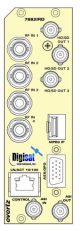
Evertz 7881IRD2 Digital Terrestrial/Cable/Satellite SD/HD Dual Modular Integrated Receiver Decoder

8x8 up to maximum frame configurations 64x128 or 128x64

7881IRD2 Professional IRD
The Evertz 7881IRD2 series is the basis of a professional platform for receiving, demodulating and decoding digital ATSC/DVB-T/T2/ISDBTb/DVB-C/C2/DVB-S/S2 satellite signals. With a compact, modular form-factor the IRD2 represents one of the highest density and most flexible solutions in the industry. The unit may be mounted in the Evertz 7800 series of enclosures, providing a high-density, modular solution. Options for an innovative removable front control panel and 1RU chassis also allow the IRD to be packaged in the traditional form-factor, while maintaining all of the benefits of modularity.
Applications include signal reception for broadcasters, cable, DTH and IPTV providers, or any other small to large head-end operators who need to receive and utilize or re-distribute satellite content, and also receive and distribute off-air local contents.
The 7881IRD2 series provides ASI and IP outputs, ideal for turnaround, transcoding, monitoring or other applications where the received signal remains in the compressed domain. For baseband output, the 7881IRD2 utilizes an advanced decoder with support for both MPEG-2 and H.264/AVC, SD or HD encoded signals, optionally up to 4:2:2 10-bit.
Full monitoring and control of the IRD are relayed over SNMP, for convenient remote access using Evertz own VistaLINK PRO SNMP monitoring and control package. Additionally, low-speed data support is provided for in-band control.
For applications requiring decryption, the 81 series provides two slots for installation of a customer-supplied conditional access module. DVB-CI compliant conditional access modules and formats are supported.

Features
- Modular design, allowing flexible configurations along with easy system reconfiguration and service
- May be mounted in the 7800FR series frames in high–density applications
- Use with 7801FR and fitted with the 7801CP control panel, yielding a 1 RU IRDA with removable front control panel and optional redundant power supplies, all of which are hot–swappable and may be serviced without any decabling required
- Up to two units may be mounted in the 7801FR and used with the 7801CP, providing a dual IRD solution in 1RU
- Future proof with upgrade paths to support future modulation and encoding technologies
- Standard support for advanced modulation schemes, including DVB–S2 with 16APSK and 32APSK
- Flexible decoding of SD and HD as standard
- Support for encoding profiles from distribution to contribution grade, including H.264 in 4:2:0 8–bit and optional 4:2:2 10–bit formats “software upgradable", along with legacy MPEG–2
- Available DVB–CI slot for conditional access modules
- Available BISS and BISS–E decryption
- Flexible mid–stage access to compressed domain signals, including ASI and optional IP output along with ASI and optional IP inputs
- Straight pass through or PID filtering/remapping of compressed stream outputs
- Standard Dolby pass through and decode of Dolby AC–3 and MPEG–2 Layer 1 audio
- Optional decoding of Dolby E, Plus and AAC
- Eight AES outputs
- Optional Audio Video Monitoring (AVM) for audio mute and video freeze and black detection
- Control through web browser or SNMP using third–party application or Evertz' own VistaLINK SNMP control and monitoring software
- Optional SCTE 105/34 translation
- Ability to store ten preset configurations
- Event log support with exporting capabilities are supported on VLPRO
- Built–in control port for direct control and management of the IRDA
RF Input:
Number: 4
Connector: F–Type
For –LB version:
Frequency: 950–2150 MHz
Power: -20 to –60dBm
LNB power: Activated on selected input
Current: 400mA
Voltage: 13, 18V (selectable)
LO Control: 22kHz (on/off selectable)
For –ATSC/DVBT/T2 and ISDBTb version: Frequency: 50–860MHz
Input Power: 40 to –40 dBmV per carrier Channel Bandwidth: 6MHz, 7MHz, 8MHz
Modulation Support:
For –LB version:
Symbol Rate: Up to:
8PSK: 67 Msps
16APSK: 50 Msps
32APSK: 40 Msps
Coding Rates:
DVB–S QPSK: 1/2, 2/3, 3/4, 5/6, 7/8
DVB–S2 QPSK: 1/4, 1/3, 2/5, 1/2, 3/5, 2/3,
3/4, 4/5, 5/6, 8/9, 9/10
DVB–S2 8PSK: 3/5, 2/3, 3/4, 5/6, 8/9, 9/10 DVB–S2 16APSK: 2/3, 3/4, 4/5, 5/6, 8/9, 9/10 DVB–S2 32APSK: 3/4, 4/5, 5/6, 8/9, 9/10
For –ATSC version:
8VSB Demodulation Standard:
ATSC Per A53
QAM Demodulation Standard:
ITU–TJ.83 Annex B, QAM 64, 256
For –DVBC2/DVBT2/ISDBT2 version:
Channel Bandwidth: 6MHz, 7MHz, 8MHz
(1.7MHz available for DVB–T2)
Sub Format: QAM16–QAM256, QPSK
Standard: DVB–T/T2, DVB–C/C2, ISDBTb (ITU–T J.83 Annex A and C)
Code Rate: 1/2, 2/3, 3/4, 5/6, 7/8 auto detection
FFT Mode: K2, K4, K8, K16, K32 auto detection Guard Interval: 1/32, 1/16, 1/8, 1/4, 1/128, 19/128,
19/256, 1/64 auto detection
Pilot Pattern: PP1, PP2, PP3, PP4, PP5, PP6, PP7, PP8 auto detection
MPEG over IP Input/Output:
Connector: 1x RJ–45, 10/100/1000
Streams: 2
Type: SMPTE ST 2022–1, –2
Conditional Access Support:
- 2x DVB–CI slots
Baseband Video Outputs (Dual Decode*):
Number: 3
Connector: BNC
Type: SDI (SMPTE ST 259), HD–SDI (SMPTE ST 292–1)
* Both channels must decode the same codec on both services
AES Audio Outputs:
Number: 8 (4x AES per decode)
Connector: BNC breakout from DB–15
Type: Unbalanced AES
Audio Processing:
- Supports decoding of MPEG–1 Layer 2, AAC, Dolby® E, Dolby® Plus and AC3
- Supports Dolby® E and AC3 pass–through
ASI Input/Output:
Number: 2 (configurable input/output)
Type: ASI per DVB TR101–891
Connector: 75Ω BNC
Frame Sync (+FSE Option):
- Sync 1080i/59.94, 1080i/50, 720p/59.94, 720p/50, 525i/59.94, 625i/50
- Video delay between 3 lines and 1 frame + 3 lines
- Programmable output phase with respect to reference input
- Reference input via common 7800FR frame reference connector
Monitored parameters:
For –ATSC and –DVBT2/ISDBTb version:
- Demodulator lock
- MER/BER
- Packet errors
- TR101–P1 Errors
Control:
- SNMP over Ethernet via frame controller
- Web browser
Electrical:
Power: < 46 Watts
Voltage: 12VDC
Temperature: 0–50°C
Physical:
Number of Slots: 2
Content Delivery via Satellite, Modular design, allowing flexible configurations along with easy system reconfiguration and service