
Comtech CEFD XPA Milsatcom X-Band Rack Mount High Power Amplifier Systems
7.80 to 8.40 GHz, available in 175 and 200W Configurations
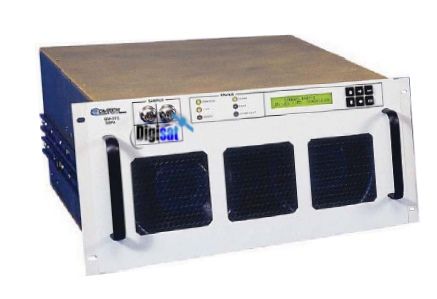
XPA Milsatcom X-Band Rack Mount High Power Amplifier Systems
This product has reached end of life and is no longer available. Please contact us for a suitable replacement.
The Comtech EF Data Model XPA Indoor X-Band Solid State Power Amplifier (SSPA) delivers 175, or 200 Watts guaranteed, at the 1 dB compression point, to the transmit waveguide flange. It provides a cost effective and more reliable replacement for Traveling Wave Tube (TWT) amplifiers in X-Band terminals. Due to its small rack height, it is also ideal for the construction of small “flyaway” terminals, medium size (equivalent to Intelsat F) earth stations, and hub earth stations for small to medium size private networks, or point-to-point links.
Solid-State Amplifier Advantages
The XPA SSPA is constructed with highly reliable Gallium Arsenide Field Effect Transistors (GaAs FETs). With third order inter-modulation products from 4 to 6 dB better than TWT ratings, the XPA unit replaces TWTs with saturated power levels up to 400 Watts. The XPA also provides a Mean Time Between Failure (MTBF) that is 5 to 6 times greater than the typical TWT MTBFs.

Options Included Free
The XPA series of SSPAs come equipped with useful features that other manufacturers offer as options. Included in the base price are temperature compensation, sample ports, power monitor, rack slides, and full remote monitor and control capabilities.
Functional Description
The SSPA consists of a chassis, power supply, fan assembly, front panel assembly, Monitor/Control Processor (MCP), and an SSPA module. The amplifier was designed using a Comtech EF Data low-loss combining technique and an MCP-based temperature versus gain compensation.
Front Panel
The SSPA front panel contains a user-friendly Liquid Crystal Display (LCD) menu display and cursor control keys in order to display status or change parameters. The front panel also has LEDs for quick reference to binary status points and both input and output sample ports at -20 and -40 dBc for easy test point access.
Built-In Redundancy Controller
Each SSPA amplifier has the ability to function as a 1+1 or 1+2 redundancy controller in the backup mode. The optional redundancy configuration is implemented by attaching a ganged waveguide/coax transfer switch(es) to the input and output connectors of the amplifiers with a combination coaxial cable and waveguide kit. When the backup SSPA is commanded into the controller mode, it monitors the online SSPA(s) for faults. A faulted online unit may be disconnected and replaced without affecting the online power amplifier.
Remote Control
The remote control interface is selectable between EIA-232 and EIA-485, as well as full Ethernet including Telnet, SNMP and pre-loaded HTML GUI. All configuration control, status retrieval, and adjustments are available as simple ASCII commands through the serial interface or through the front panel menu. As a cost option, the remote control command structure can be customized in order to accommodate existing network control software.
|
Output Frequency 7.9 to 8.4 GHz |
|||
|
Power |
|
||
|
XPA-175 |
52.2 dBm min. @ 1 dB compression |
||
|
XPA-200 |
53.0 dBm min. @ 1 dB compression |
||
|
Mute |
-60 dB |
||
|
Impedance |
50 n |
||
|
VSWR |
1.25:1 maximum |
||
|
Connector |
CPR-112G waveguide |
||
|
Gain |
|||
|
Linear |
|
||
|
XPA-175 |
62.0 dB min., 65 dB typical |
||
|
XPA-200 |
62.0 dB min., 67 dB typical |
||
|
Adjust XPA-175/200 |
20 dB in 0.25 dB steps |
||
|
Full Band |
|
||
|
XPA-175/200 |
_ 0.75 dB |
||
|
Per 40 MHz |
|
||
|
XPA-175/200 |
_ 0.25 dB |
||
|
Third Order Inter-Modulation |
|||
|
Intercept |
|
||
|
XPA-175/200 |
+60.5 dBm min., 62.0 typical |
||
|
Products |
|
||
|
XPA-175/200 |
–30 dBc typical, -25 dBc max. @ 3 dB total backoff |
||
|
|
(two tone, _ f+1MHz) |
||
Typical Users
Large Military Earth Stations
Government Agencies
Common Applications
Medium size earth stations & hub earth stations
Small to medium sized DKET Terminals and secure private networks
Point-to-point links
